Launch offer — valid today only

📄 Digital book in PDF · read it on your phone or print it

Diesel Heaters Illustrated: Fitting and Fault-Finding in Drawings One Job on Every Page

Siting, the fuel line and dosing pump, the exhaust route, ducting, 12 V wiring and the fuse, first start, the CO alarm, fault trees and the winter service. Every topic has its own page: the drawing first, then what you need to remember. 64 illustrated pages.

START FITTING IT THIS WAY

🔒 Secure checkout · PDF by email · 30-day guarantee

Every topic, its own pageEvery job drawn, with the explanation alongside
64 illustrated pages9 parts, from how the heater works to the quick review
Up-to-date sourcesMaker's instructions, Boat Safety Scheme and BS EN 50291-2
PDF by emailFormat

Look Inside the Book

Every page has one big drawing and a box with the measurements, ratings and checks you need to know:

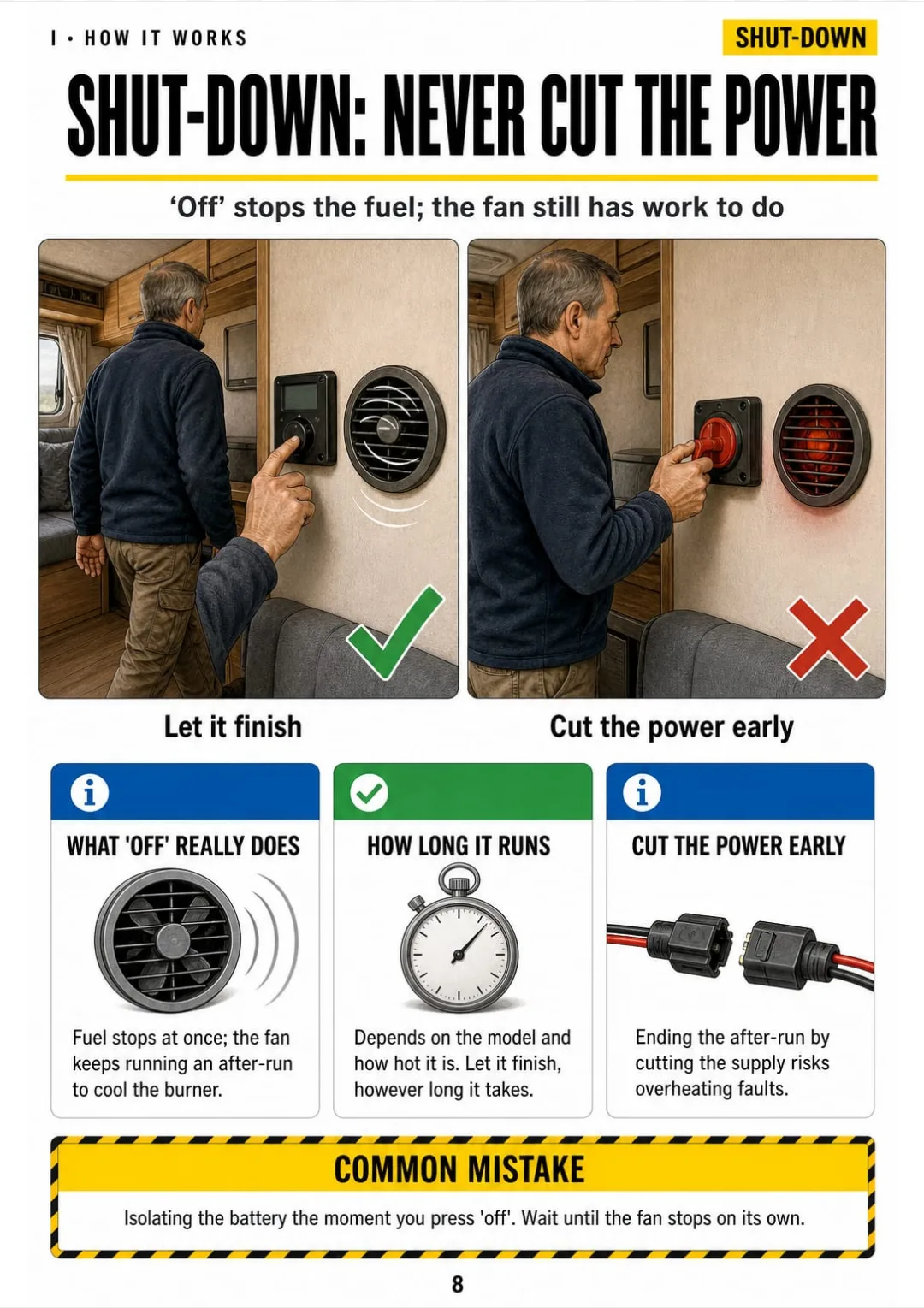
Right vs wrong: let the after-run finish before you isolate the battery
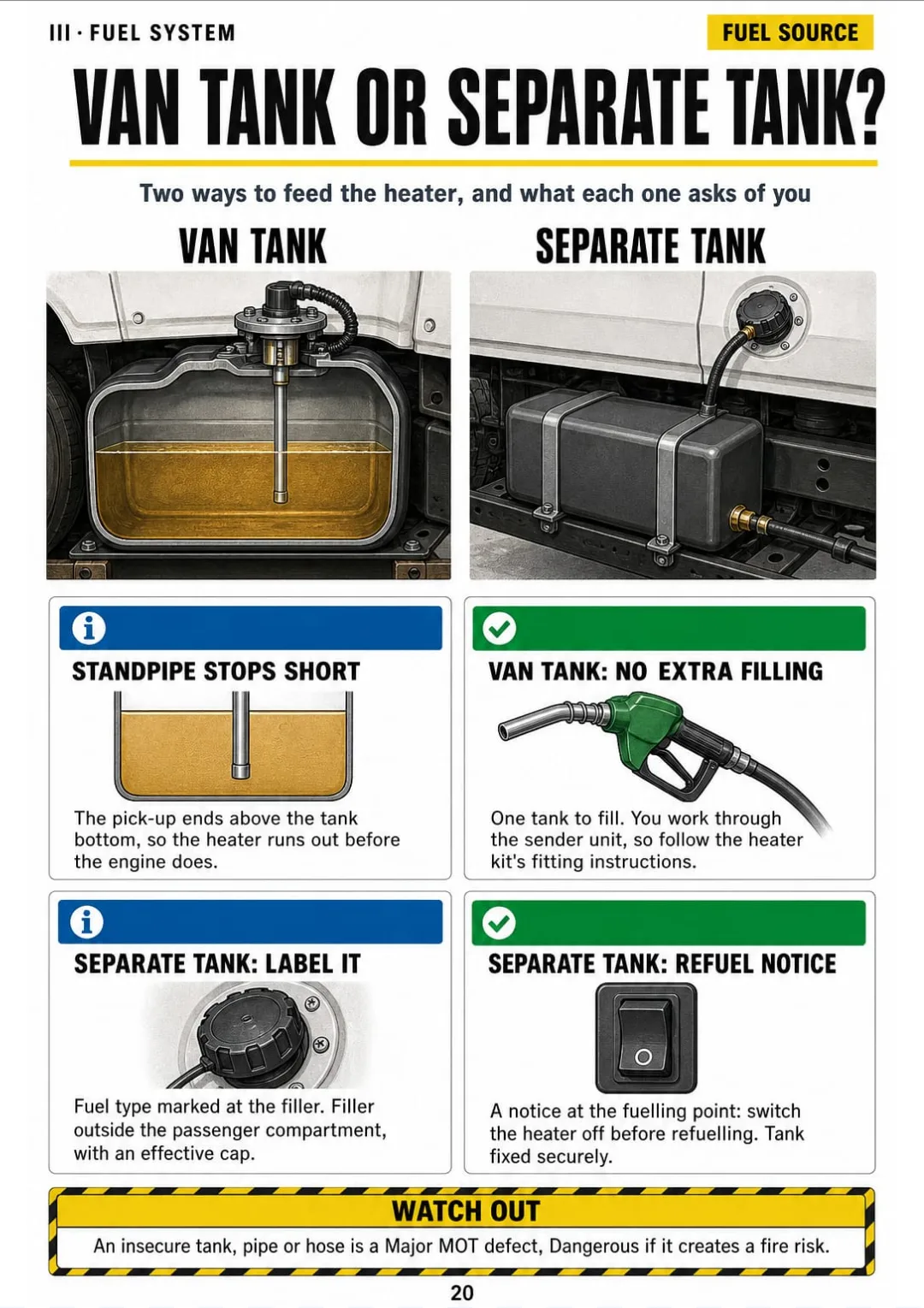
The pick-up stops above the bottom so you never run the main tank dry
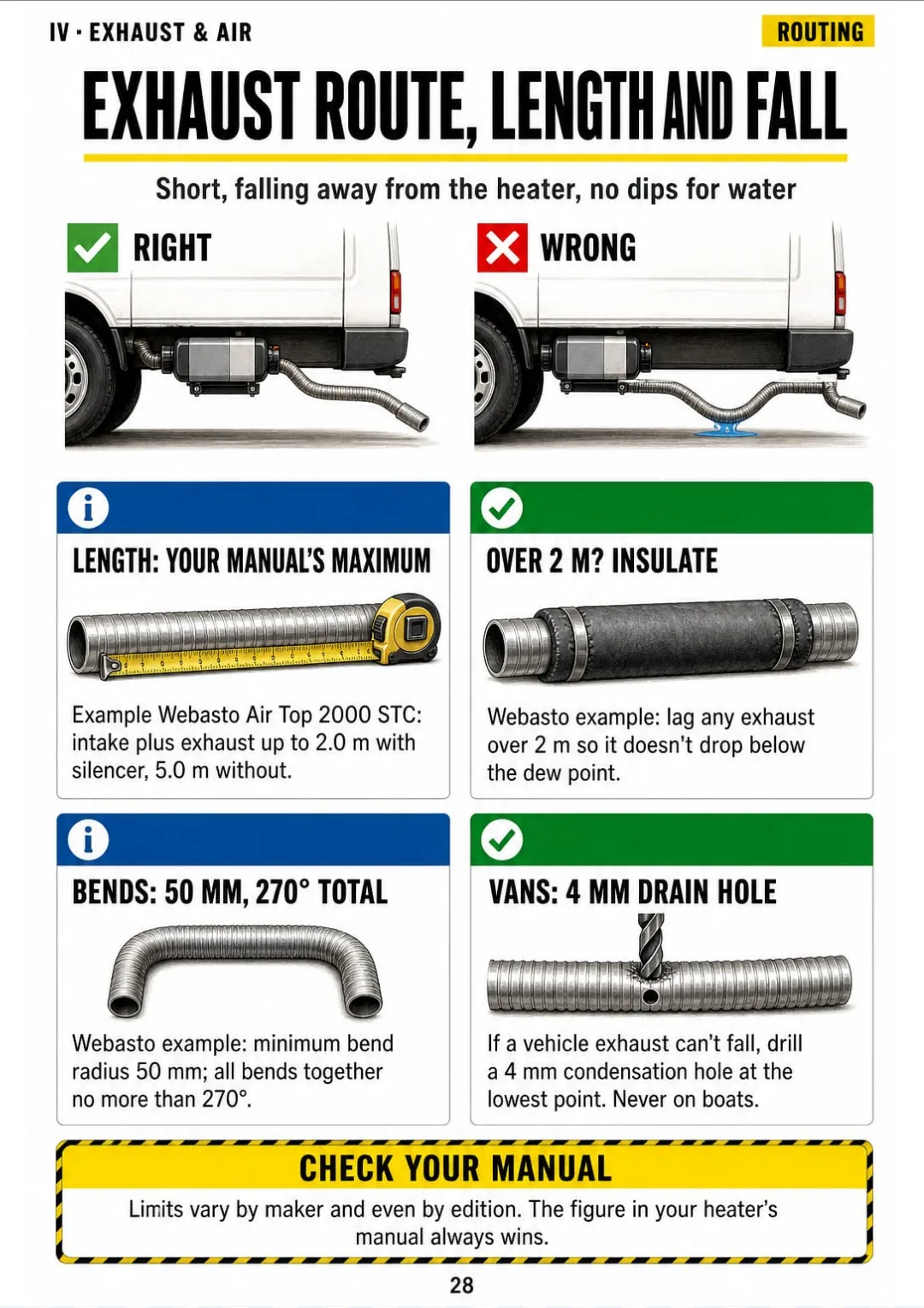
Example limits: 2.0 m with silencer, 50 mm bend radius, bends up to 270° in total
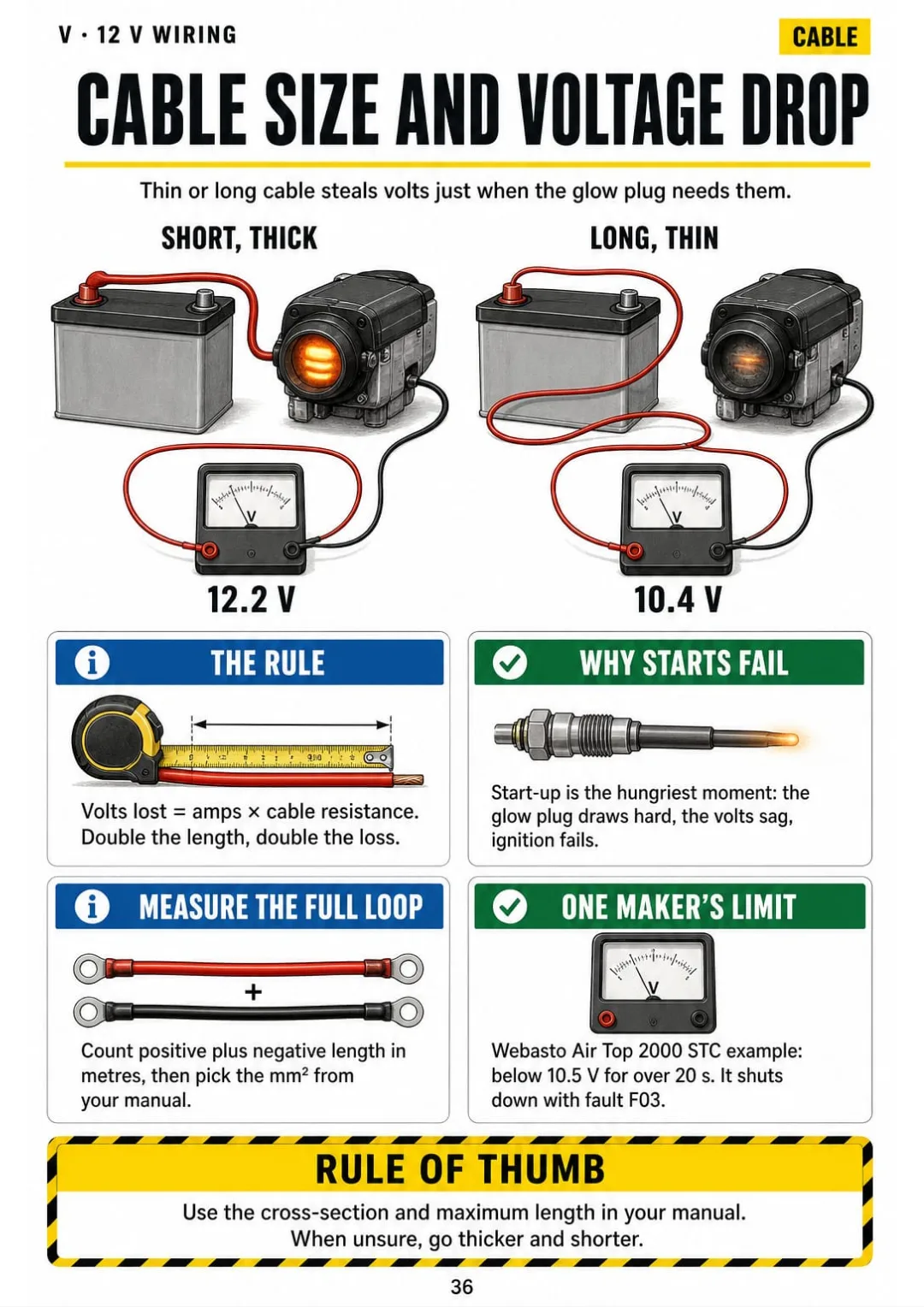
Volts lost = amps × resistance: double the cable length, double the drop at the glow plug.
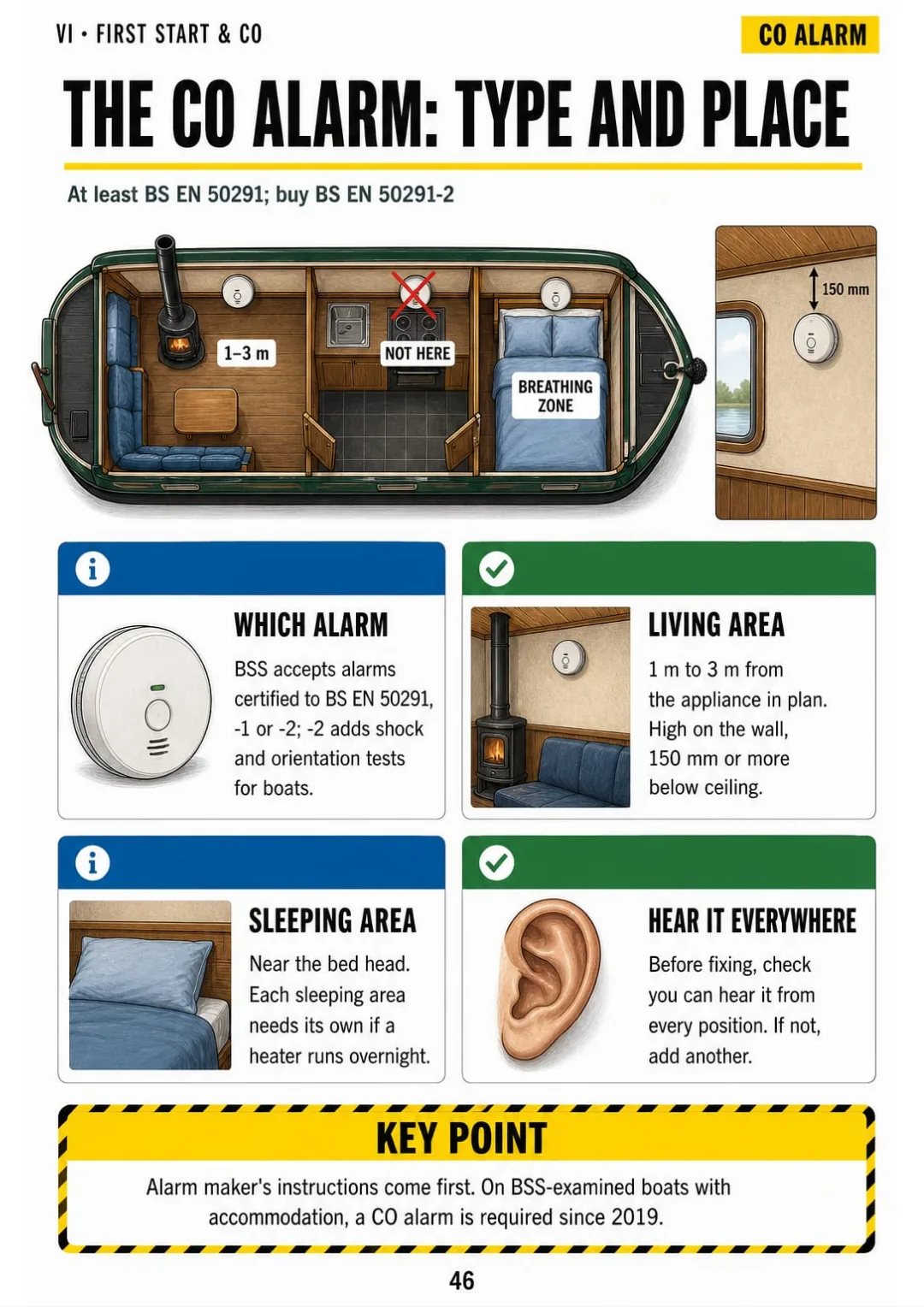
CO alarm: BS EN 50291-2, 1–3 m from the heater, 150 mm below ceiling, one by the bed
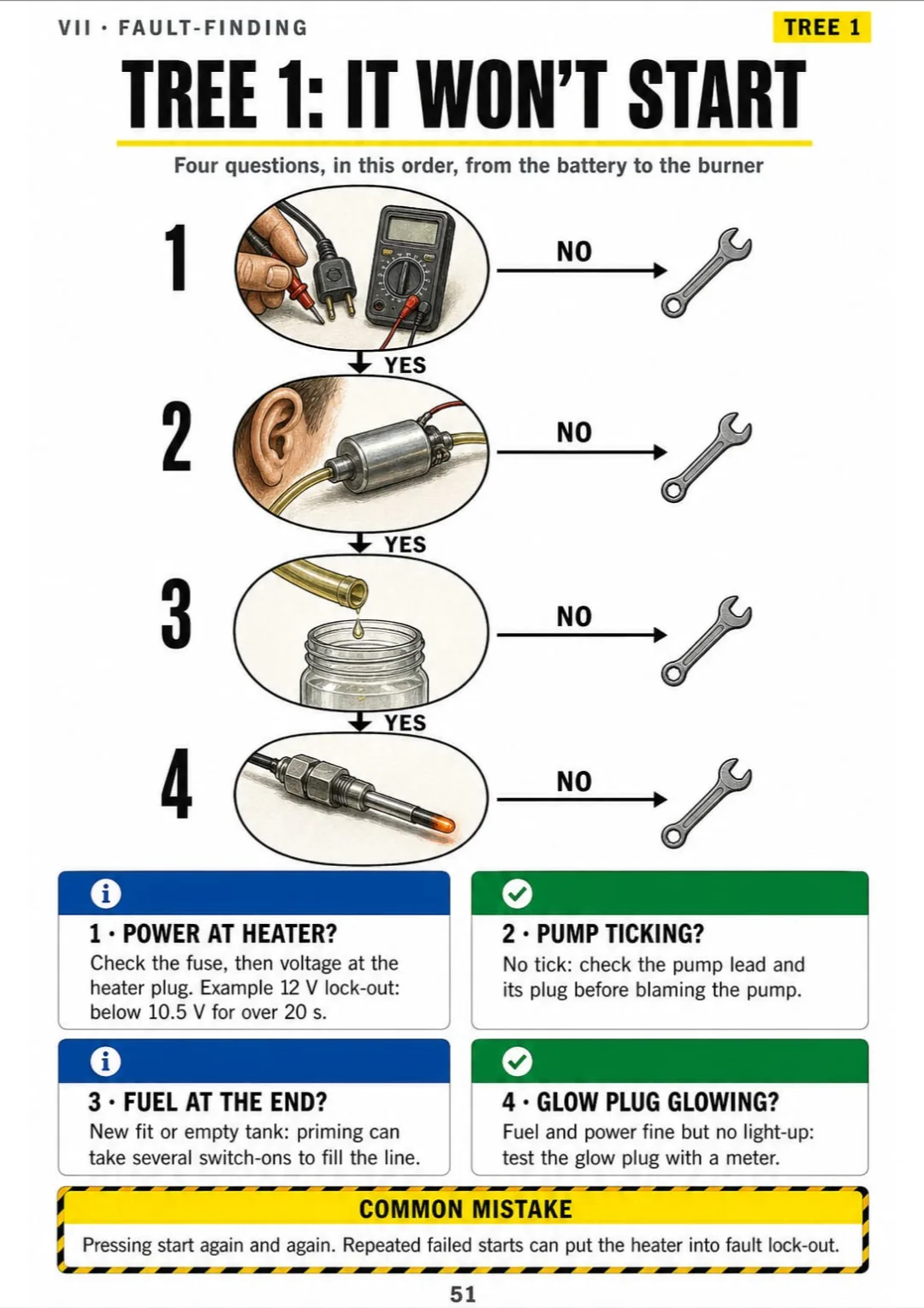
Tree 1: power, pump tick, fuel at the heater end, glow plug
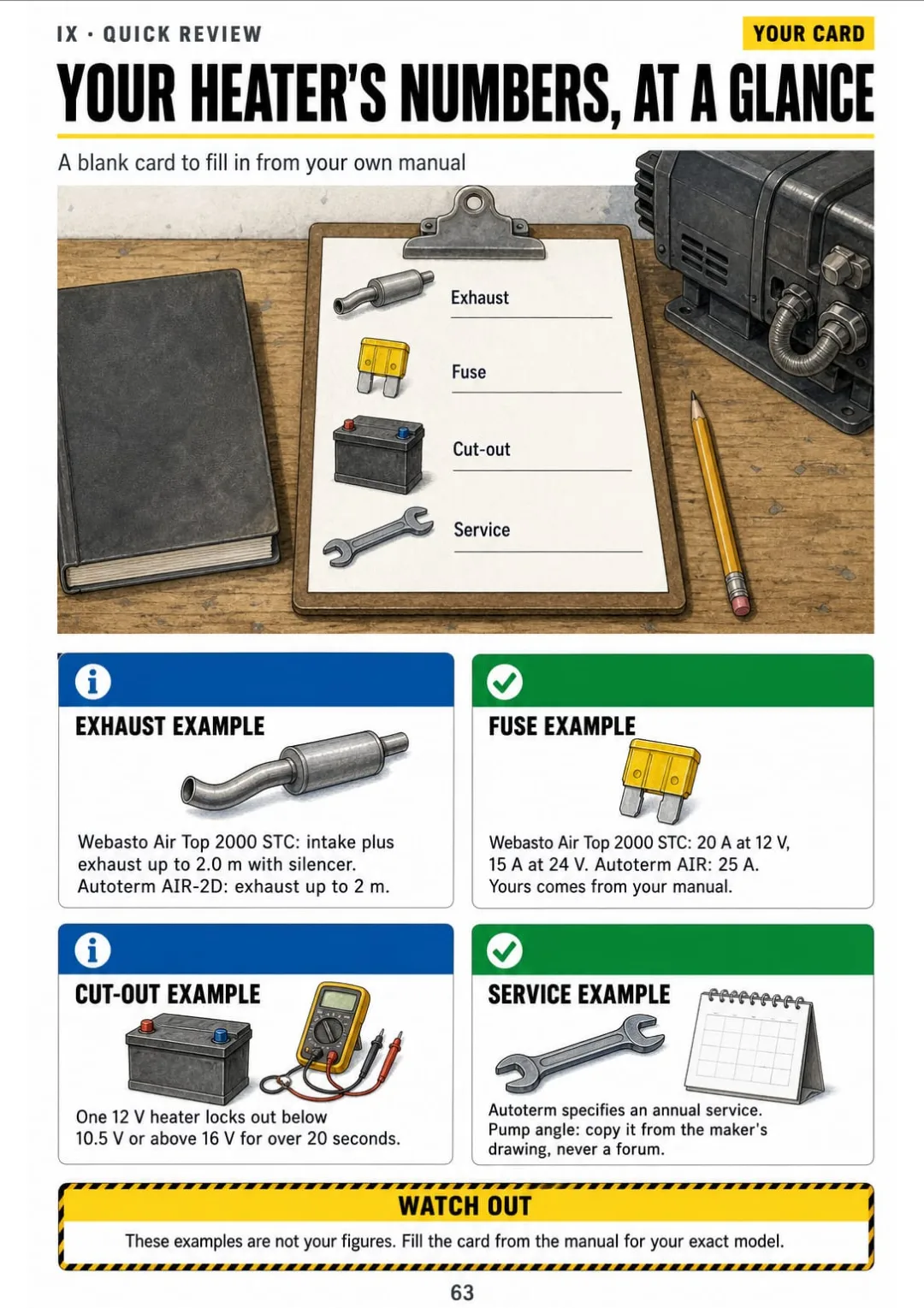
Fill-in card: exhaust length, fuel line, pump angle, fuse, cut-out voltage, service interval
Hand it over: boat examiner, auto-electrician or heater specialist, with your manual first

Swipe to see more →

These are real pages from the book. The table of contents is the full one: 9 parts and 60 topics.

The Problem Isn't You. It's How It Was Explained.

You're under the van with the heater bolted in and the exhaust pipe in your hand, working out which way it should run to the outlet.

The leaflet in the box covers length, bends and fall in two lines of broken English, and the three videos you watched route it three different ways. That's guesswork.

Example limits: 2.0 m with silencer, 50 mm bend radius, bends up to 270° in total

In the book, the exhaust route is one drawing: the pipe from the heater through the silencer to the outlet, the fall marked so condensation drains, and the example limits in a box: up to 2.0 m including the silencer, no bend tighter than 50 mm radius, no more than 270° of bends in total, to check against your maker's manual.

The same goes for the dosing pump angle, the fuel line joints, the fuse and where it sits, the CO alarm and the fault trees: each one has its own page.

You look at the drawing, check it against your manual and route the pipe without going back to the leaflet.

COMPARE FOR YOURSELF

The Same Topic, Two Ways to Learn It

THIS
  • The manual: line after line
  • The fuel route explained in words alone
  • You start the job still unsure
Fuel shall be drawn from the vehicle tank by means of a dedicated standpipe, or from an auxiliary tank, and conveyed via the inline filter to the metering pump, which shall be mounted within the angular tolerance specified by the manufacturer. The delivery line between pump and heater shall be of the specified internal bore, with all butt joints made using suitable sleeves and clips and the pipe ends abutting without gap, so as to prevent vapour formation. Each connection shall be inspected for leakage prior to commissioning.
FOR THIS
  • The fuel route in one drawing
  • The joints to check, numbered in a box
  • You see it and you get it
The pick-up stops above the bottom so you never run the main tank dry
CONTENTS

Take a Look at the 9 Parts and 60 Topics

How it works, siting, the fuel system, exhaust and ducting, 12 V wiring, first start and CO safety, fault-finding, service and a quick review: 64 pages, all illustrated

IHow a Diesel Air Heater Works · pp. 5-11
  1. The heater, cut open
  2. Two airs, never mixed
  3. The start-up sequence, second by second
  4. The shut-down cycle and why you never cut the power
  5. 2 kW or 5 kW: sizing for your space
  6. What a budget heater shares with the dear ones
  7. Fuel, power and air: the three things it eats
IISiting the Heater · pp. 12-18
  1. Where it goes: the four questions
  2. Mounting angle and the flat base
  3. Siting in a panel van
  4. Siting on a narrowboat or yacht
  5. Siting in a workshop or garage
  6. Measuring and marking the hole
  7. Sealing the floor
IIIThe Fuel System · pp. 19-26
  1. The fuel system on one page
  2. Tapping the vehicle tank or fitting a separate one
  3. The dosing pump and its angle
  4. Fuel line: bore, length and joints
  5. Routing the line away from heat
  6. The inline filter
  7. Boat fuel systems: the extra rules
  8. Priming the line
IVExhaust, Intake and Ducting · pp. 27-34
  1. The exhaust: the most important page
  2. Exhaust route, length and fall
  3. Where the exhaust outlet must not be
  4. Clamping, heat shields and clearances
  5. Exhaust through a hull or wall
  6. The combustion air intake
  7. Ducting the warm air
  8. Recirculation vs fresh air on the cabin side
V12 V Wiring and the Controller · pp. 35-41
  1. The loom, laid out
  2. Cable size and voltage drop
  3. The fuse: rating and position
  4. Leisure battery, split charge and solar
  5. The pump lead
  6. Controllers: rotary, LCD and Bluetooth
  7. Earth points and connections
VIFirst Start and CO Safety · pp. 42-48
  1. Commissioning checklist before power-on
  2. The first start, watched
  3. Leak test after the first run
  4. Carbon monoxide: what it does
  5. The CO alarm: type and placement
  6. Testing and replacing the CO alarm
  7. Sleeping with it on: the honest checklist
VIIFault-Finding · pp. 49-56
  1. How to use a fault tree
  2. Reading fault codes
  3. Tree 1: it won't start
  4. Tree 2: white smoke
  5. Tree 3: black smoke and soot
  6. Tree 4: it starts, then cuts out
  7. Tree 5: noisy, smelly or not warm enough
  8. Testing the glow plug and pump with a meter
VIIIService and Winter Care · pp. 57-60
  1. The seasonal service routine
  2. De-coking the burner
  3. Winter diesel and waxing
  4. Laying up a boat or van for the winter
IXQuick Review · pp. 61-64
  1. The most common installation mistakes
  2. The whole fit in one page
  3. Your heater's numbers, at a glance
  4. Before you call it a day

One Page, One Topic, All Clear

Think of it this way:

It's the first cold night on the boat, the heater clicks, whirs and stops, and you need to know where to start before you start swapping parts.

You open the book at Tree 1 and follow it from the top: power, the pump tick, fuel at the heater end, then the glow plug, each check drawn with what to look for.

CO alarm: BS EN 50291-2, 1–3 m from the heater, 150 mm below ceiling, one by the bed

The same goes for white smoke, black smoke, cutting out, the exhaust route and the CO alarm: each one on its own page.

Diesel Heaters Illustrated is 9 parts and 60 topics, all drawn, with the most common installation mistakes, the whole fit on one page and your heater's numbers at a glance at the end.

What you see drawn, you don't have to memorize.

What's Inside Diesel Heaters Illustrated:

Ipp. 5-11

How a Diesel Air Heater Works

The heater cut open, the two air circuits, start-up and shut-down second by second, sizing 2 or 5 kW, and what a budget heater shares with the dear ones.

IIpp. 12-18

Siting the Heater

The four siting questions, mounting angle and flat base, siting in a panel van, on a boat and in a workshop, marking the hole and sealing the floor.

IIIpp. 19-26

The Fuel System

You run the fuel from tank to heater without a leak: tapping the tank or a separate one, the dosing pump angle, line bore and butted joints, routing away from heat, the filter, boat rules and priming.

IVpp. 27-34

Exhaust, Intake and Ducting

The exhaust route, length and fall, where the outlet must not be, clamps and heat shields, going through a hull or wall, the intake and the warm-air ducting.

Vpp. 35-41

12 V Wiring and the Controller

The loom laid out, cable size and voltage drop, fuse rating and position, leisure battery and solar, the pump lead, controllers and earth points.

VIpp. 42-48

First Start and CO Safety

The commissioning checklist, the first start watched, the leak test, what CO does, the CO alarm type, placement and testing, and the sleeping checklist.

VIIpp. 49-56

Fault-Finding

You find the fault before buying parts: how to read a fault tree and the codes, five trees from won't start to not warm enough, and the glow plug and pump tested with a meter.

VIIIpp. 57-60

Service and Winter Care

The seasonal service, de-coking the burner, winter diesel and waxing, and laying up a boat or van for the winter.

IXpp. 61-64

Quick Review

The most common installation mistakes, the whole fit on one page, your heater's numbers at a glance and the final checks before you call it a day.

At the end of the book: 5 fault trees, the most common installation mistakes and the whole fit on one page.
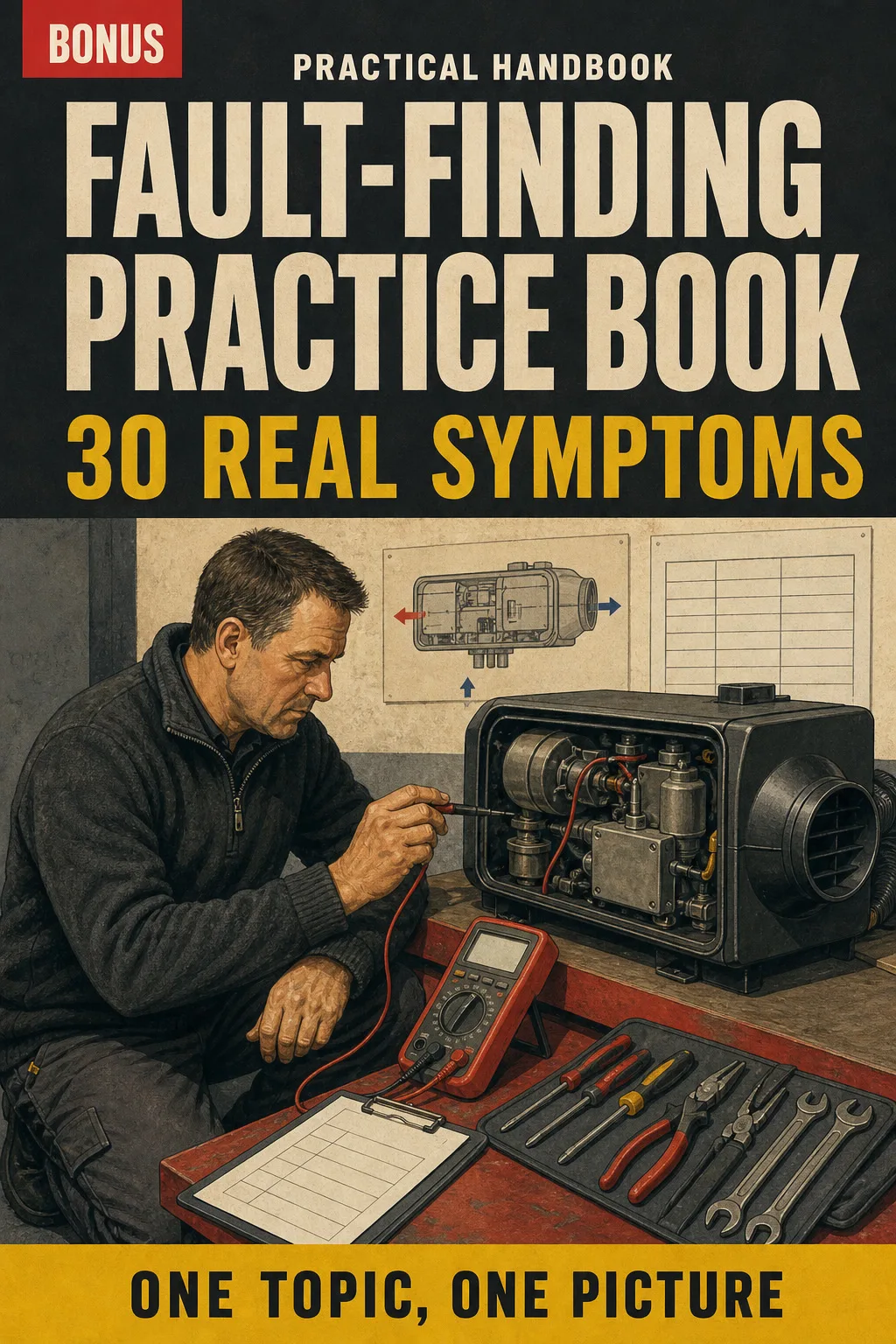
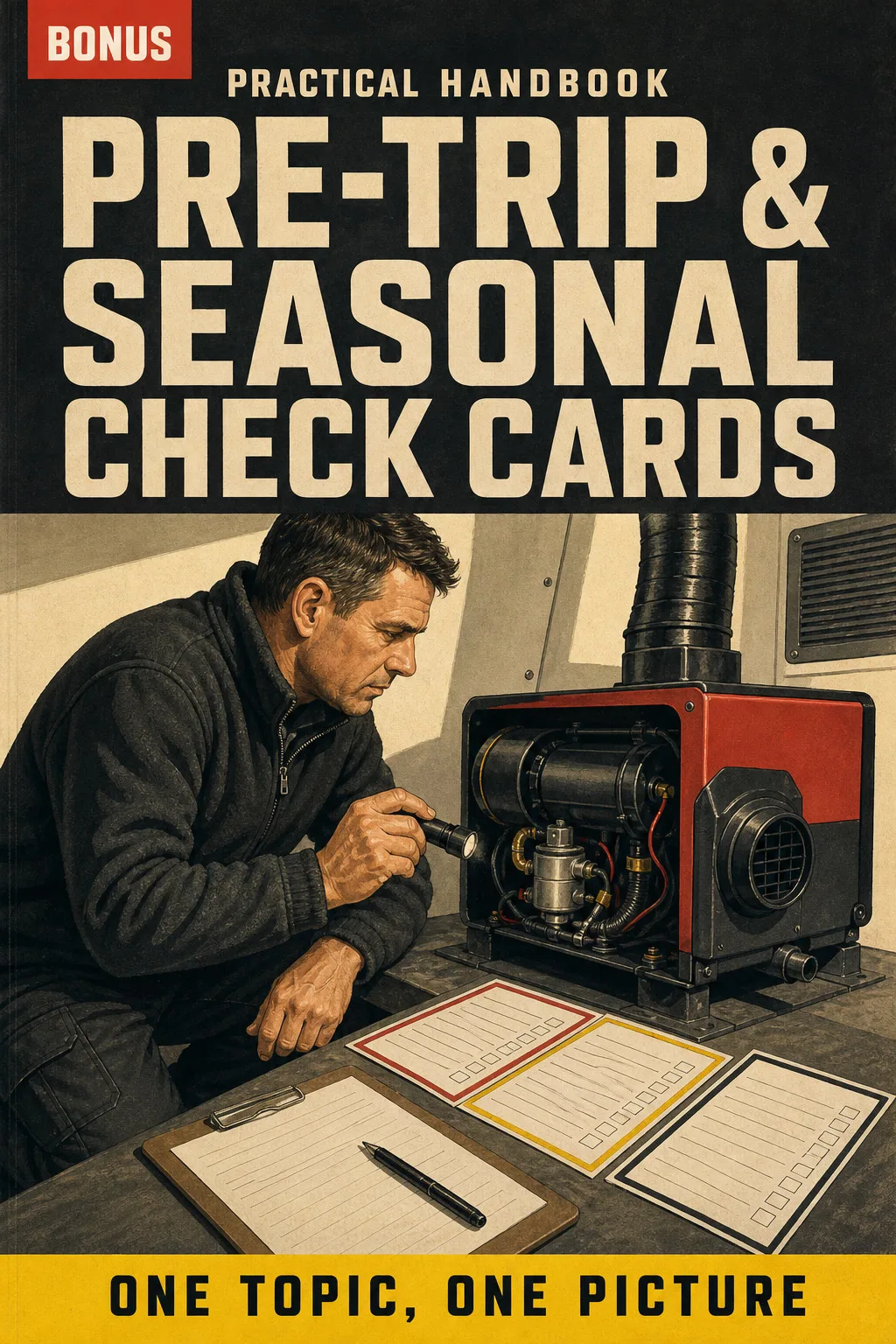
Plus: 2 Free Books

Fault-Finding Practice Book: 30 Real Symptoms

BONUS 1: «Fault-Finding Practice Book: 30 Real Symptoms»

Value on its own: US$ 17.90

Work through 30 real cases (no start, white smoke, cutting out, fault codes) and check your answer, so you know where to start when your own heater plays up.

Pre-Trip & Seasonal Check Cards

BONUS 2: «Pre-Trip & Seasonal Check Cards»

Value on its own: US$ 14.90

Printable cards for the van, boat or workshop: first-start checklist, pre-trip CO checks and the seasonal service routine, at a glance.

Diesel Heaters Illustrated with 2 Free Books

  • Diesel Heaters Illustrated: 64 illustrated pagesUS$ 63
  • BONUS 1: Fault-Finding Practice Book: 30 Real SymptomsUS$ 17.90
  • BONUS 2: Pre-Trip & Seasonal Check CardsUS$ 14.90
  • High-resolution PDF to printIncluded
Total value US$ 95.80
YOUR PRICE:
US$ 27
You save US$ 68.80
YES, I WANT DIESEL HEATERS ILLUSTRATED FOR US$ 27

📄 This is a digital PDF book sent to your email: nothing is printed or shipped.

Secure purchaseEncrypted payment30-day guarantee

PDF by email: We email you Diesel Heaters Illustrated as a PDF, together with the two free books. It's a single payment: no installments, no extra charges.

Who This Book Is For

You're planning the conversion

You're planning the conversion

You see where the heater, the pump and the exhaust go before you drill a single hole.

You're fitting it this weekend

You're fitting it this weekend

You follow the 8 jobs in order and do the first start with the commissioning checklist in your hand.

Yours is already running

Yours is already running

When it smokes or cuts out, you follow the fault tree from the top. Before the boat's safety examination, you go over the fuel joints and the CO alarm page by page.

Everything You Get Today

US$ 95.80US$ 27
YES, I WANT DIESEL HEATERS ILLUSTRATED FOR US$ 27

📄 This is a digital PDF book sent to your email: nothing is printed or shipped.

30DAYS
GUARANTEE

30-Day Guarantee

Try Diesel Heaters Illustrated for 30 days, bonus books included.

We refund everything if the file won't open, if the book isn't what you see here, if you were charged twice or if the email doesn't arrive. Just email us.

You pay once. No subscriptions.

Frequently Asked Questions

Is it for me if I've got a budget heater for my van, boat or workshop?

Yes. Budget 2 kW and 5 kW air heaters work the same way as the dear ones, and the book has a page on what they share. Van, boat and workshop each get their own siting page. Fault codes vary between controllers, so the book shows you how to read yours against its manual. Always check against your maker's instructions.

Where does the content come from?

From heater makers' installation instructions, checked against current UK guidance: Boat Safety Scheme requirements, BS EN 50291-2 for CO alarms and BS EN ISO 10088 for fuel systems on small craft. Every interval, distance and fuse rating is marked to check against your manual.

Is this official material?

No. It's an independent illustrated book. It isn't issued or endorsed by any heater maker, standards body or scheme, and it isn't a certificate: it doesn't sign off your install or replace a Boat Safety Scheme examination.

Does it replace the maker's instructions or a competent installer?

No. It helps you understand and follow them. Your maker's instructions come first, and if you're in doubt, especially on a boat, ask a competent installer.

Are the practice cases from an official test?

No. The 30 symptoms in the practice book are written for this book, to practise the fault trees. They aren't taken from any official test or inspection.

When and how do I get it?

The book and the 2 bonus books arrive as a PDF by email, at the address you enter at checkout.

Do I have to pay every month?

No. It's a one-off payment.

Can I have it on paper?

Yes. It's a printable PDF: print the whole book or just the pages you want in the workshop or on board.

How does the refund work?

You have 30 days. We refund everything if the file won't open, if the book isn't what you see on this page, if you were charged twice or if the email doesn't arrive: just email us.

Before You Close This Page

No more rereading the leaflet and getting nowhere.

The exhaust route is drawn: you look once and you know.

You start the job knowing where everything goes.

Drawings make studying faster.

The book is right below.

One-time payment: US$ 27 · Guarantee: 30 days · PDF by email

YES, I WANT DIESEL HEATERS ILLUSTRATED FOR US$ 27

📄 This is a digital PDF book sent to your email: nothing is printed or shipped.